October 2026

Scattered Threads

Dealers and collectors once cut up textiles and manuscripts and sold the pieces separately. Many ended up in different museums, cataloged apart and often with conflicting dates and attributions.

This AI-assisted search compares 43,874 open-access photographs from five collections to trace these scattered threads. Some findings may already be known to specialists, but are not mentioned by the museums' online records.

Learn more about the method here.

Details
AI role
Claude Opus 5.5 (reasoning: high) ran an autonomous search for 12 hours on a MacBook Air. It wrote the code, ran matching algorithms, read museum records, drafted initial descriptions, and implemented this web page.
Human role
Ryan Xu reviewed all findings, identified false matches, edited all text, chose the pairs to highlight, and designed this web page.
Method
We used an image model, DINOv2 from Meta, to find look-alike photographs across the five museums. We then kept only pairs whose fine details line up, and excluded things made in multiples, such as carpets, handkerchiefs, lace, and printed books. Claude compared the strongest pairs at full resolution and read each museum's record.
Sources
Open-access photographs and records from the V&A, the Cleveland Museum of Art, the Art Institute of Chicago, the Met, and the Rijksmuseum.

Front and back of the same robe?

Rank Badge (buzi), Cleveland Museum of Art
Cleveland 1948.71 Rank Badge (buzi)1736–95
Rank badge with qilin, The Metropolitan Museum of Art
The Met 46.133.2 Rank badge with qilin19th century

Qing officials wore embroidered badges on the front and back of their robes to show their rank. These two show a qilin in gold thread, the emblem of a first-rank military officer, leaping beneath a red sun over rocks and churning waves. Even the bats in the clouds match. Cleveland's is cut down the middle; the Met's is whole.

As Cleveland's page explains, badges were made in identical pairs, with the front one split so the robe could open. Cleveland dates its badge to 1736–95, the Met to the 19th century.

The similarities are striking and may indicate that these are the front and back of the same robe, in which case the two dates would need reconciling.

Museum records
Cleveland Museum of Art 1948.71
  • 1736–95, Qianlong reign. 25.4 × 25.1 cm.
  • Catalog text: badges “were woven in pairs with identical imagery,” one divided vertically for the front of the robe.
  • Bought in 1948.
The Metropolitan Museum of Art 46.133.2
  • 19th century. Chinese title 清晚期 一品武官麒麟補: late Qing, qilin badge of a first-rank military official. 25.4 × 25.4 cm.
  • Private collection, New York, until 1946.

Read on each museum's collection website, 22 October 2026.

Cushions made for one household?

Cushion Cover, Art Institute of Chicago
Chicago 1989.149 Cushion Cover1601
Cushion cover, The Metropolitan Museum of Art
The Met 64.101.1272 Cushion cover1601

Both cushion covers are embroidered with Tudor roses, flowers rising from vases, and interlaced ribbons. Both carry the same initials and date: N W, C W, 1601. One is the mirror image of the other, possibly with different coloring.

Chicago's cover was sold at Christie's in 1988; the Met's came from the collection of Irwin Untermyer in 1964. Neither record mentions the other.

It is possible they were made as a set for one household, perhaps for a couple, N.W. and C.W. Matching sets of cushions were common in English houses of the period.

Museum records
Art Institute of Chicago 1989.149
  • England, 1601. Inscription “N W 1601 C W.” 49.5 × 52.8 cm.
  • Christie's South Kensington, Fine Needlework and Costume, 17 May 1988 (catalog cover). Published in Thurman, Textiles in The Art Institute of Chicago (1992).
The Metropolitan Museum of Art 64.101.1272
  • British, 1601. Inscription “N.W. 1601 C. W..” 45.7 × 48.3 cm.
  • Irwin Untermyer, New York, until 1964. Exhibited 1945, 1947, 1963–64, and 2008–09.

Read on each museum's collection website, 22 October 2026.

Nasrid Spain, or a Moroccan belt?

Textile Fragment, The Metropolitan Museum of Art
The Met 2002.494.742 Textile Fragmentlate 15th–16th c.
Fragment of a belt (hizam), Cleveland Museum of Art
Cleveland 1918.192 Fragment of a belt (hizam)1800s

Both silks have rows of scalloped medallions, each holding an eight-pointed star, with small flower motifs and dark triangular palmettes between them. The two share the same three-band belt layout and width, but the star centers and colors differ, so these are related designs rather than one.

The Met dates its piece to 15th–16th-century Spain and compares it to Nasrid designs at the Alhambra. Cleveland catalogs its piece as a 19th-century Moroccan belt.

Weavers in Fez kept Nasrid patterns in use for centuries, which may explain the match.

Museum records
The Metropolitan Museum of Art 2002.494.742
  • Late 15th–16th century, made in Spain. On view in Gallery 457.
  • Gallery label: relates the design to Nasrid tile work, woodwork, and plaster, and to the Alhambra.
  • Kelekian gift, 2002.
Cleveland Museum of Art 1918.192
  • 1800s, Morocco. Silk, lampas weave.
  • Described as a fragment of a hizam, a belt worn by elite Moroccan women.
  • Cites The Fabric of Moroccan Life (Indianapolis Museum of Art, 2002).

Read on each museum's collection website, 22 October 2026.

Mirror-image printed cottons

Fragment of Copperplate Printed Cotton, Cleveland Museum of Art
Cleveland 1927.430 Fragment of Copperplate Printed Cottonc. 1785
Pagoda on a Rock Bridge, Victoria and Albert Museum
V&A T.316-1919 Pagoda on a Rock Bridgecirca 1775–92

V&A image: © Victoria and Albert Museum, London

These copperplate-printed cottons share the same Chinese-style scenes: a pavilion with two seated men, ladies at a table beneath a gnarled tree, a pagoda on an arched rock bridge. Every scene on one is the mirror image of the other, so they were printed from different plates. Both museums attribute theirs to Oberkampf's factory at Jouy. Tracing a print onto a new plate reverses it, so one may be a copy.

Museum records
Cleveland Museum of Art 1927.430
  • Maker: Christophe Philippe Oberkampf. France, c. 1785.
Victoria and Albert Museum T.316-1919
  • Titled Pagoda on a Rock Bridge. Jouy-en-Josas, Oberkampf, c. 1775–92.

A hunting silk in three museums

Textile Fragment, The Metropolitan Museum of Art
The Met 1970.300.1 Textile Fragment10th–11th century
Fragment with Mounted Hunter Spearing Animals, Cleveland Museum of Art
Cleveland 1982.22 Fragment with Mounted Hunter Spearing Animalsbefore 1982
Woven Silk Fragment, Art Institute of Chicago
Chicago 1983.527 Woven Silk FragmentAbout 1930–50

A crowned rider on a fantastic mount spears an ibex beside a tree. Silks at the Met, Cleveland, and Chicago show the same scene, even the rows of imitation lettering on the saddle cloth. The Met dates its piece to the 10th–11th century. Chicago calls its own a 20th-century imitation, and Cleveland gives only “before 1982.” This group of “Buyid” silks is well studied, so the link may be well known.

Museum records
The Metropolitan Museum of Art 1970.300.1
  • 10th–11th century, attributed to Iran. Private collection until 1970.
Cleveland Museum of Art 1982.22
  • Before 1982; Iran, style of the Abbasid or Buyid period. Lampas weave. Spink & Son, London, 1982.
Art Institute of Chicago 1983.527
  • About 1930–50, imitation of a 10th- or 11th-century pattern. Twill compound weave. Woodruff, Los Angeles; Adolph Loewi; bought 1983.

Two leaves from a Book of Hours

The Visitation, from a Book of Hours, Art Institute of Chicago
Chicago RX20769/1963 The Visitation, from a Book of Hours1440s
Leaf from a Book of Hours: The Nativity (recto), Cleveland Museum of Art
Cleveland 2014.23.a Leaf from a Book of Hours: The Nativity (recto)c. 1430

Chicago's page shows the Visitation; Cleveland's, the Nativity. Both measure about 17 by 12.5 cm. Each has an arched painting above the words “Deus in adiutorium” (“O God, come to my aid”), with the same blue-and-gold initial and flowered ivy borders. In a Book of Hours these two scenes open neighboring sections. Chicago dates its page to the 1440s and Cleveland to about 1430; they may come from one book.

Museum records
Art Institute of Chicago RX20769/1963
  • France, possibly Paris or Brittany, 1440s. 17 × 12.6 cm.
Cleveland Museum of Art 2014.23.a
  • Northeastern France, c. 1430. 17 × 12.5 cm. From the dealer Bruce Ferrini. Published by Fliegel (1999).

Two leaves from a law book

Leaf Excised from Henry of Segusio's "Summa Aurea": Table of Consanguinity, Cleveland Museum of Art
Cleveland 1954.1 Leaf Excised from Henry of Segusio's "Summa Aurea": Table of Consanguinityc. 1280
Table of Bigamy, from the Summa Super Titulis Decretalium Completa, Art Institute of Chicago
Chicago 1929.277 Table of Bigamy, from the Summa Super Titulis Decretalium Completa1275/99

Both pages come from copies of the same 13th-century textbook of church law, and each is dominated by a painted figure holding a diagram. In Cleveland a crowned king holds a chart of family relationships; in Chicago a haloed figure holds a chain of roundels between heaven and a hell-mouth. The page size, layout, and faces agree, though the frames differ. Cleveland says Paris; Chicago says England, by a French artist. A 2018 census of these diagrams (Duba and Flüeler, in Fragmentology) lists Cleveland's leaf but does not connect it to Chicago's. They may come from one book.

Museum records
Cleveland Museum of Art 1954.1
  • Paris, c. 1280. 44.2 × 27.5 cm. Published by Milliken (1954).
Art Institute of Chicago 1929.277
  • 1275–99. Place: England; artist: French (likely Toulouse). 44.5 × 28 cm.

Tunic ornaments from Egypt

Fragment, Victoria and Albert Museum
V&A 1272-1888 Fragment4th/5th century
Fragment with an Eight-Pointed Star Containing a Warrior, The Metropolitan Museum of Art
The Met 89.18.242 Fragment with an Eight-Pointed Star Containing a Warrior4th–6th century

V&A image: © Victoria and Albert Museum, London

These late-antique ornaments from Egypt are tapestry-woven in purple wool. In each, a warrior raises a double axe inside a ring of vases and vines, framed by an eight-pointed star. Even the gesture matches. They reached London and New York through different dealers in the late 1880s. Ornaments like these were woven in pairs for a tunic, but also to standard designs.

Museum records
Victoria and Albert Museum 1272-1888
  • Akhmim, 4th–5th century. Bought from the Rev. Greville John Chester.
The Metropolitan Museum of Art 89.18.242
  • Egypt, 4th–6th century. Theodor Graf, Vienna, 1887–89. Published by Stauffer (1995) and Thomas (2016).

One pattern, two colorways
Length of Fabric, Cleveland Museum of Art
Cleveland 1954.318.a Length of Fabric1500s
Panel, Victoria and Albert Museum
V&A 127A-1880 Panel16th century

V&A image: © Victoria and Albert Museum, London

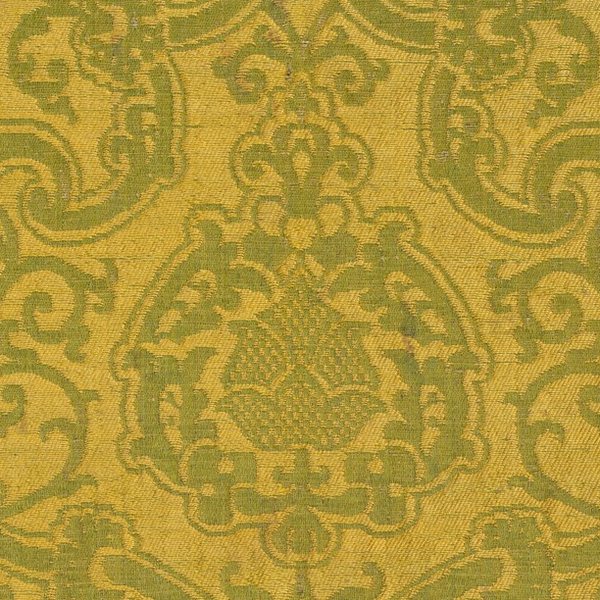
Both silks carry a lattice of scrolling stems around pomegranates and fleurs-de-lis, drawn identically: green on gold in Cleveland, rose on gold at the V&A. A loom set up for one pattern could weave it in any colors.

Museum records
Cleveland Museum of Art 1954.318.a
  • Italy or Spain, 1500s. From José Viñas, Barcelona.
Victoria and Albert Museum 127A-1880
  • Italian lampas, 16th century.

Two Chimú cloths from Peru

Large Cloth, Cleveland Museum of Art
Cleveland 1953.288 Large Cloth1460–1632
Embroidered Panel with Figure, The Metropolitan Museum of Art
The Met 1978.412.12 Embroidered Panel with Figure12th–15th century

Both cloths show a frontal figure with a heart on its chest, its stepped arms ending in reed boats ridden by crested birds. The composition matches, but the details are drawn differently, so these are two cloths made from one model. Both passed through the New York dealer John Wise. Cleveland's is radiocarbon-dated to 1460–1632; the Met dates its own to the 12th–15th century.

Museum records
Cleveland Museum of Art 1953.288
  • Radiocarbon date 1460–1632. Chimú-Inka, brocaded. Gift of John Wise.
The Metropolitan Museum of Art 1978.412.12
  • Chimú, 12th–15th century; described as embroidered. John Wise Ltd. until 1956. Published by Rowe (1984).

Prodigal Son cushion covers

Cushion cover, Victoria and Albert Museum
V&A T.1-1933 Cushion cover1600–1610
"The Repentance of the Prodigal Son" from a set of six of The Parable of the Prodigal Son, The Metropolitan Museum of Art
The Met 54.7.7 "The Repentance of the Prodigal Son" from a set of six of The Parable of the Prodigal Sonearly 17th century

V&A image: © Victoria and Albert Museum, London

Each tapestry cushion cover shows a different scene from the story of the Prodigal Son, inside the same border of standing figures, baskets of fruit, and huntsmen chasing deer. The weavers may have worked from the same drawing, or in the same workshop. The Met's belongs to a set of six that it attributes to London; the V&A attributes its own to the Sheldon workshops in Warwickshire.

Museum records
Victoria and Albert Museum T.1-1933
  • Sheldon workshops, Warwickshire, 1600–1610.
The Metropolitan Museum of Art 54.7.7
  • From a set of six. British, probably London, early 17th century.
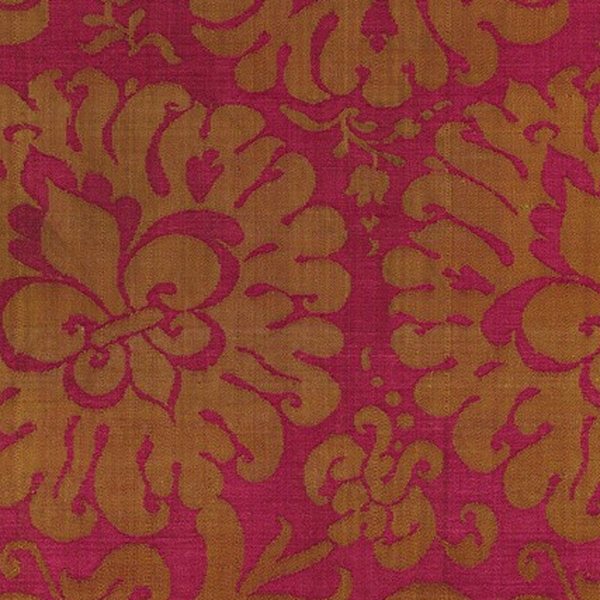
A damask, front and back

Fragment, Art Institute of Chicago
Chicago 1895.676 Fragment1601/25
Woven silk, Victoria and Albert Museum
V&A 1220-1877 Woven silk1500–1699

V&A image: © Victoria and Albert Museum, London

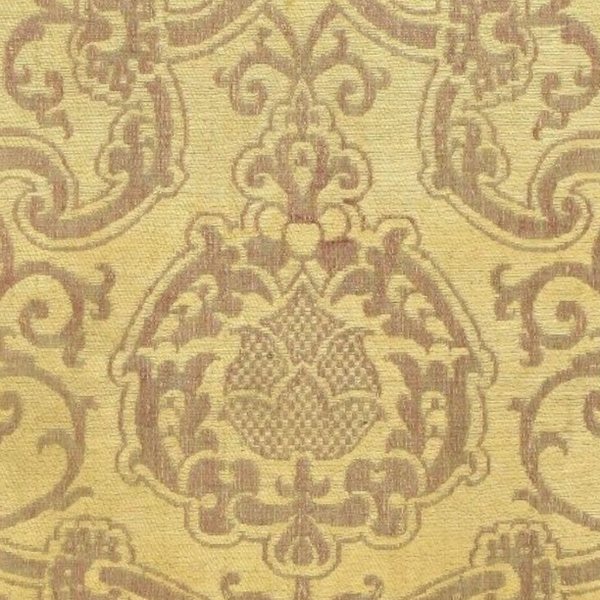
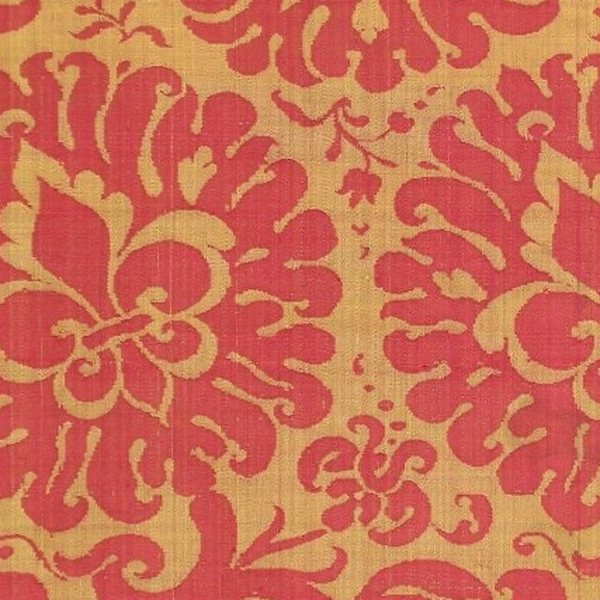
Both silks have large leafy rosettes on a ringed stem, crimson and gold in Chicago, gold and red at the V&A. They match only when one is mirrored and its colors swapped, which is how the two faces of a damask look. Chicago says France, 1601–25; the V&A says Italy, 1500–1699.

Museum records
Art Institute of Chicago 1895.676
  • France, 1601–25. Satin weave self-patterned by reversing of faces.
Victoria and Albert Museum 1220-1877
  • Damask, Italian, 1500–1699.

Choir-book initials

Decorated Initial "E" with Flowers from a Choir Book, Art Institute of Chicago
Chicago 1924.155 Decorated Initial "E" with Flowers from a Choir Book14th c. or modern
Decorated initial from the Murano Gradual, Victoria and Albert Museum
V&A 4003 Decorated initial from the Murano Graduallate 15th century
Decorated Initial "M" in Pink with Conventional Leaves from a Choir Book, Art Institute of Chicago
Chicago 1925.60 Decorated Initial "M" in Pink with Conventional Leaves from a Choir Book14th c. or modern
Decorated initial from the Murano Gradual, Victoria and Albert Museum
V&A 3000 Decorated initial from the Murano Gradual

V&A image: © Victoria and Albert Museum, London

These decorated initials, cut from choir books, are painted on gold grounds, with letters edged in pearl-like dots and sprays of five-petaled flowers. Chicago catalogs its set as “14th century or modern, c. 1920.” The V&A has initials in the same style, dated to the late 15th century, which entered the museum in 1864. So Chicago's follow a genuine 15th-century model, whatever their own date.

Museum records
Art Institute of Chicago 1924.155
  • 14th century or modern, c. 1920. Given in 1924.
Victoria and Albert Museum 4003
  • Late 15th century. One of eleven initials transferred to the museum in 1864.

Ottoman embroidered covers
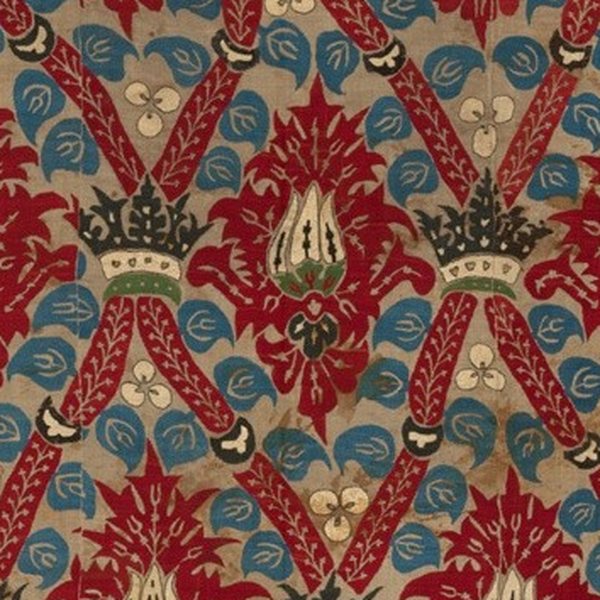
Cover, Art Institute of Chicago
Chicago 1956.1252 Cover1601‒1875
Hanging, Victoria and Albert Museum
V&A 155-1893 Hanging1500–1599

V&A image: © Victoria and Albert Museum, London

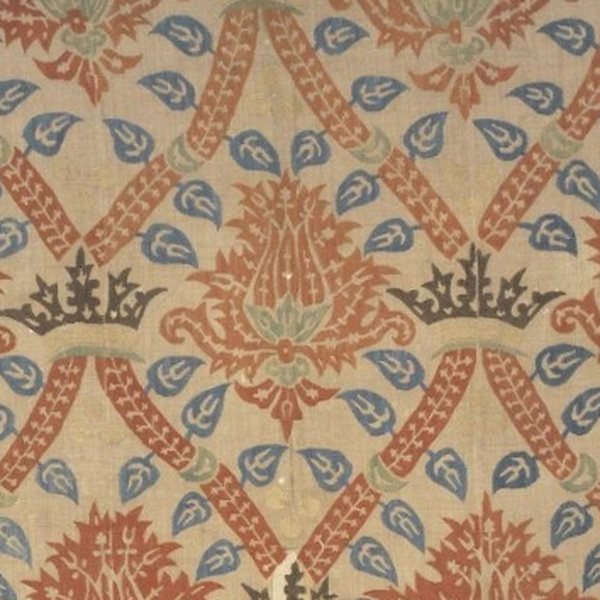
Both Ottoman embroideries follow one pattern: leafy ribbons meeting at crowns around large serrated carnations. One looks much paler than the other. Chicago dates its cover anywhere from 1601 to 1875; the V&A dates its own to the 1500s.

Museum records
Art Institute of Chicago 1956.1252
  • Turkey, 1601–1875. Gift of Burton Y. Berry.
Victoria and Albert Museum 155-1893
  • Turkey, 1500–1599. Published by Ellis and Wearden (2001).

Danish Palm Sunday cloths

Panel (Depicting Christ Entering Jerusalem), Art Institute of Chicago
Chicago 1984.1068 Panel (Depicting Christ Entering Jerusalem)17th century
Length, The Metropolitan Museum of Art
The Met 1971.136.5 Length17th century

Both cloths are double-woven in blue and white, at the same loom width, with rows of Christ riding into Jerusalem, palm-wavers, trees full of birds, and towered churches. The Met's piece, over eleven meters long, is photographed from its other side. Both museums say 17th-century Denmark.

Museum records
Art Institute of Chicago 1984.1068
  • Denmark, Schleswig-Holstein, 17th century. Linen and wool.
The Metropolitan Museum of Art 1971.136.5
  • Danish, Jutland, 17th century. Wool and cotton.

Already on record

The search also found these pairs, but the museums' own records or labels already link them or explain why they match. They show that it recovers known connections, and that the records are worth reading before claiming anything new.

Velvet with tied branches

Fragment, Art Institute of Chicago
Chicago 1895.866 Fragment16th century
Woven silk, Victoria and Albert Museum
V&A 843-1894 Woven silk1500s

V&A image: © Victoria and Albert Museum, London

Chicago's velvet, with branches tied by a ribbon, matches a V&A velvet line for line. Chicago's record cites a 1907 catalog by Isabelle Errera that lists similar pieces, including one at the South Kensington Museum (now the V&A), then called Italian. That is probably this V&A velvet, now cataloged as Spanish.

Crowned-lion silks from Granada

Fragment with crowned lions, palmettes, and escutcheons, Cleveland Museum of Art
Cleveland 1944.240 Fragment with crowned lions, palmettes, and escutcheons1400s-1500s
Lampas, Victoria and Albert Museum
V&A 678D-1896 Lampas1490–1550

V&A image: © Victoria and Albert Museum, London

Cleveland's and the V&A's crowned-lion silks share one design. The Met's gallery label notes that more than twenty such silks survive, and the V&A says the design survives in numbers that imply mass production.

Venetian silk with deer

Fragment, Art Institute of Chicago
Chicago 1940.926 Fragment1401–1450
Textile Fragment with Recumbent Harts, Eagles, Clouds, and Sunrays, The Metropolitan Museum of Art
The Met 46.156.36a, b Textile Fragment with Recumbent Harts, Eagles, Clouds, and Sunrays1390s

A Venetian silk with collared deer and sunbursts, in Chicago and at the Met. Chicago's record lists publications of “similar fragments.” The Met notes that a similar silk appears in a portrait of Richard II.

Pugin's monograms for Chirk Castle

Myddelton Biddulph Armorial Medallion, Art Institute of Chicago
Chicago 2005.69 Myddelton Biddulph Armorial Medallionc. 1846
Roundel, Victoria and Albert Museum
V&A T.267:2-2004 Roundel1845–1855

V&A image: © Victoria and Albert Museum, London

Embroidered monograms designed by A.W.N. Pugin for the curtains of Chirk Castle, in the same design but different colors. The V&A bought its pair at Christie's in June 2004, and Chicago acquired its piece the following year.

French lace-pattern silk

Panel, Victoria and Albert Museum
V&A T.719-1972 Panel1720–1725
Zijdeweefsel met een 'kantpatroon' en metaaldraad, Rijksmuseum
Rijksmuseum BK-1971-229-B Zijdeweefsel met een 'kantpatroon' en metaaldraadc. 1720

V&A image: © Victoria and Albert Museum, London

A French silk of about 1720, at the V&A and the Rijksmuseum. The V&A's record notes that the Rijksmuseum has duplicates of the pieces it was given.

Tapestries with William III's arms

Wapentapijt van koning Willem III, stadhouder van de Nederlanden, en koningin Mary Stuart II, Rijksmuseum
Rijksmuseum NG-519 Wapentapijt van koning Willem III, stadhouder van de Nederlanden, en koningin Mary Stuart IIc. 1689–1694
The Arms of William and Mary, The Metropolitan Museum of Art
The Met 36.57 The Arms of William and Mary1694–1700

Tapestries of the royal arms of William III and Mary II, in the Rijksmuseum and at the Met; the Met's was woven in Brussels under Hieronymus Le Clerc.

Limitations

  • Online records only. We read what the museums publish online. Specialists may already be aware of some of these links, which may also appear in printed catalogs or object files.
  • Only photographs. No one has examined these pieces in person, and lighting, cropping, or old black-and-white photos can mislead. A visual match is a reason to look closer, not proof.
  • A partial search. Only five museums with open APIs that need no key were searched, and only their patterned textiles and manuscript leaves. Pairs within one museum were left out.
  • Lossy filtering. Each filtering step is lossy, so interesting pairs were likely lost along the way.
  • Expert opinion required. What a match might mean (e.g., a shared origin, a split set, or a misdated piece) is speculation until curators and other specialists weigh in.